For most manufacturers this, and not the CSRD, is the legal pressure that really matters. The obligation is concrete, deadline-driven and hinges on measurability: you not only have to take measures, you also have to be able to demonstrate that they fall within the payback period and that they had an effect. Without consumption data at installation level, that last point is almost impossible to prove.
Does the obligation apply to you? The threshold is per site
The threshold is 50,000 kWh of electricity or 25,000 m³ of natural gas (equivalent) per year and, importantly, it applies per site, not per organisation. A company with three locations therefore assesses each location separately. Almost every serious production site is above that limit: 50,000 kWh is the consumption of a handful of larger machines plus building services.
If you have several buildings or connections, one site may be covered while another falls just outside. That makes insight per site the first practical step.
What you have to do: the Recognised Measures List (EML)
The obligation is about taking every energy-saving measure that pays for itself within the period. The Recognised Measures List (Erkende Maatregelenlijst, EML) is the reference framework for that: for each industry sector it lists the measures that are deemed to be cost-effective. It covers both building-related measures (lighting, insulation, HVAC) and process-related measures (compressed air, cooling, motors, heat recovery).
For process-related measures the EML is often less clear-cut than for buildings; precisely there you have to substantiate yourself whether a measure is cost-effective, and that is only possible with consumption data at the level of the installation.
The payback period, and why it is changing
A measure is mandatory if it pays for itself within the payback period. That period currently stands at 5 years, but is becoming 7 years (announced as of 1 July 2027, in practice from the 2027 reporting round). That looks like a detail, but it shifts the boundary of what is mandatory: measures with a payback time of between 5 and 7 years will then fall under the obligation.
Worked example (illustrative). A measure costs € 40,000 and saves € 7,000 per year. Payback time = 40,000 ÷ 7,000 ≈ 5.7 years. Under the old limit of 5 years it fell just outside the obligation; under the new limit of 7 years it is mandatory. To be able to calculate those 5.7 years at all, you have to be able to substantiate the saving with a measurement; an estimate at plant level is not enough.
Why you cannot comply without measurement data
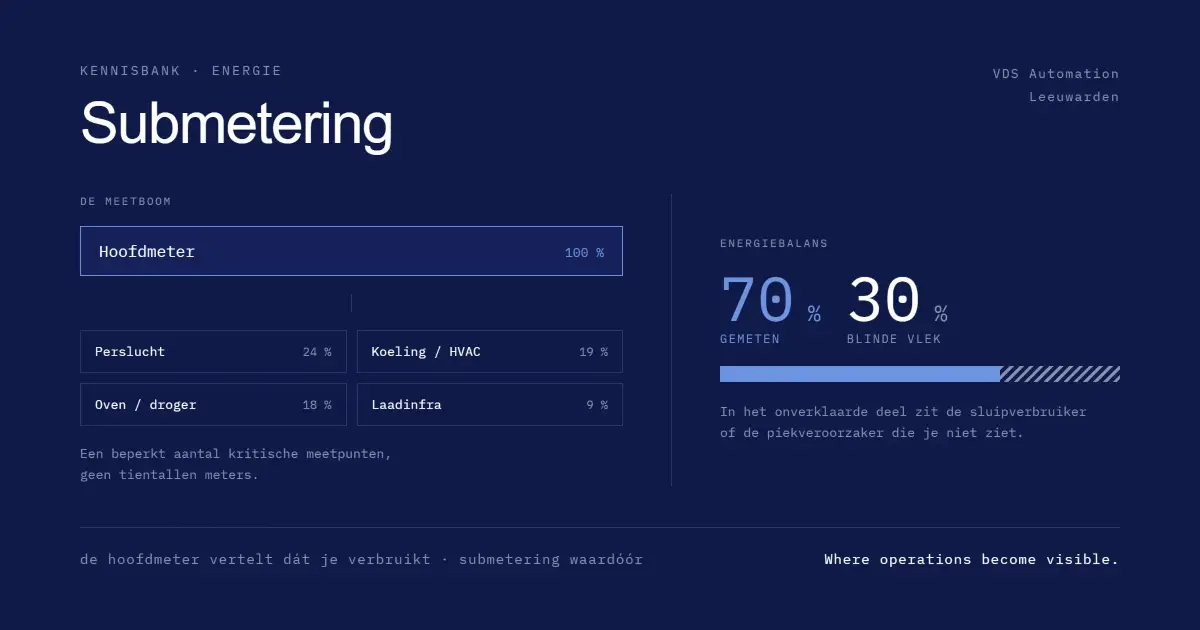
The obligation is driven by measurability: you have to be able to determine in advance whether a measure falls within the period, and to demonstrate afterwards that it had the expected effect. That is not possible on the basis of the main meter or the energy bill alone; those show the total, not the consumption per installation or process.
VDS supplies the measurement layer with which you make consumption visible at installation level and can compare the effect of a measure before and after. VDS does not advise on the measure and promises no saving; it delivers the objective data with which you make the trade-off and substantiate your reporting.
The information obligation and the investigation obligation
- Information obligation: report every four years which EML measures have been carried out, through the eLoket of RVO. The next round is 2027.
- Investigation obligation: very large consumers (indicatively from around 10 million kWh or 170,000 m³ of gas per year) additionally have to carry out a mandatory investigation into processes and installations.
Common misconception: this is not the CSRD
A lot of content files energy obligations under the CSRD. For almost every manufacturer of € 15–120M that is wrong: since the Omnibus revision the CSRD only affects companies with more than 1,000 employees and at least € 450M turnover. The binding pressure on your organisation is the energy-saving obligation (and, at higher consumption, the EED audit obligation), not the CSRD. Supply-chain pressure from large customers can play a role, but that is a different and weaker story than being subject to reporting yourself.
Sources
Frequently asked questions
Does the Dutch energy-saving obligation apply to me?
If you use more than 50,000 kWh of electricity or 25,000 m³ of gas per site per year, then almost certainly yes. The threshold applies per site, so assess every location separately.
What is the Recognised Measures List (EML)?
A list of recognised energy-saving measures per industry sector that serves as the reference: if a measure is on it and pays for itself within the period, it is in principle mandatory.
How long is the payback period?
Currently 5 years; it becomes 7 years, announced as of 1 July 2027 and in practice from the 2027 reporting round. Measures with a payback time of up to 7 years will then fall under the obligation.
When do I have to report?
Every four years through the eLoket of the Dutch enterprise agency RVO; the next round is 2027. Very large consumers additionally have an investigation obligation.
Does this fall under the CSRD?
No. The energy-saving obligation is separate from the CSRD, which after the Omnibus revision only applies from more than 1,000 employees and € 450M turnover, out of reach of almost every manufacturer in this segment.
What is the difference with the EED?
The energy-saving obligation is about taking measures and reporting on them; the EED audit obligation is about an energy audit or a certified energy management system at higher consumption (from 10 TJ per year).