
Your experienced operators are leaving. Their knowledge does not have to leave with them.
Experienced people leave, new operators spend weeks getting up to speed, and the knowledge of why things go wrong is written down nowhere. VDS Smart Factory captures that knowledge and gives your team the context they need, at the moment it matters. In plain language, at the line.
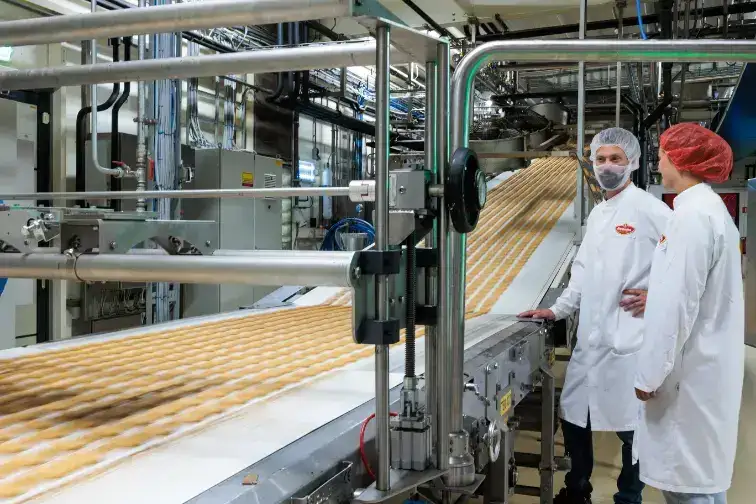
Onboarding takes weeks. And the very people who could pass it on are leaving.
Many digitalisation projects lead to more screens and more data entry, without the operator being able to steer any better. At the same time it is getting harder to get new people running independently quickly. The average onboarding time for a line operator is weeks. Meanwhile production carries on with people who do not yet know the system, do not yet recognise the signals and have not yet learned the workarounds.
VDS Smart Factory brings operational knowledge and real-time data together in one place, so the shop floor sees straight away what is going on, what is coming and what helped before.
Onboarding takes weeks
New operators learn by watching experienced colleagues. But there are fewer and fewer of them. And production does not wait until someone is ready.
Knowledge walks out
Experienced operators know why things go wrong. But it is written down nowhere.
No context with alerts
"Line 3 down" says nothing. What is the likely cause? What helped last time?
Changeover time is a black hole
Every product change costs time, but nobody knows exactly how much. Ten minutes one time, forty the next. And with a new operator it always takes longer.
Screen overload
Three systems to record the same thing. Nobody feels like the owner of the data.
Reporting after the fact
On Friday operators hear what they could have done differently on Monday. Too late.
A dashboard tells you what happened. An operator needs to know what they can do right now, while the line is running.
One screen at the line. One source of context.
At every line there is a touchscreen where the operator records downtime, sees the target and gets real-time feedback. The data comes straight from machines and sensors; the operator only has to add the causes the system cannot see for itself.
Touchscreen per line
Just three taps to record downtime with a reason. The system measures the rest itself.
Context with the target
Real-time: how many we have, how many still to go, how much time is left. No sums needed.
Ask it in plain language
"Why is line 3 down?", the AI assistant looks up the answer in your production data.
AI as a colleague, not as reporting.
Answers in your language, with your data.
AI within VDS Smart Factory helps the operator at the moment it matters. A question in everyday language, answered with figures from your own production. An alert that gives context, so people can act on the right thing.
Ask questions about your own line, get answers from your own data
"How much scrap did we have last night?" "When did this fault last occur?" The assistant looks it up in your production data and answers in plain language. No dashboard to open, no report to wait for.
With context and action, not panic
Line 3 comes to a stop. The operator sees an alert: "Film infeed blocked. Similar to the incident on 14 March. Last time solved by adjusting the right-hand tensioner." The operator acts, the line runs again. Total downtime: 4 minutes instead of 25.
Experience stays when people leave
What operators record during downtime is structured automatically. New colleagues get the right tip at the right moment, based on what experienced colleagues did before.
Faster changes, less loss at every changeover
At a product change the assistant shows the steps that work fastest for this specific combination. A new operator gets the same guidance as someone with ten years of experience. At a shift handover the next operator sees straight away where the previous one left off.
This is what is in place after delivery.
Delivered ready to use and, more importantly, your team is involved from the implementation onwards.
What changes in a day for your operator.
Not more recording, but less. And information at the moment it still makes a difference.
Shift start, no reconstruction
The screen at the line shows how the previous shift ran and which fault is still open. No handover based on memory.
A four-minute stop
The operator taps the cause on the touchscreen. The duration has already been measured. Done in five seconds, and recorded in full.
A signal before it stops
A parameter drifts away from normal. The operator gets an alert and adjusts, instead of fixing a breakdown later.
Standard and reality side by side
The screen shows what the standard is and what is actually being run. You do not need a team leader to know where you stand.
Handover on facts
The next shift starts where this one ended, with the same figures. And what the operator already knew is now in the system too.
From paper at the line to a day start on data.
At CCI, operators no longer record downtime "roughly" in the morning, but in real time on the screen at the line. Sensors measure the duration, operators add the reason in three taps. The next morning the day start begins with the same data, and with concrete actions, not with debates about what actually happened.
Read the full CCI story →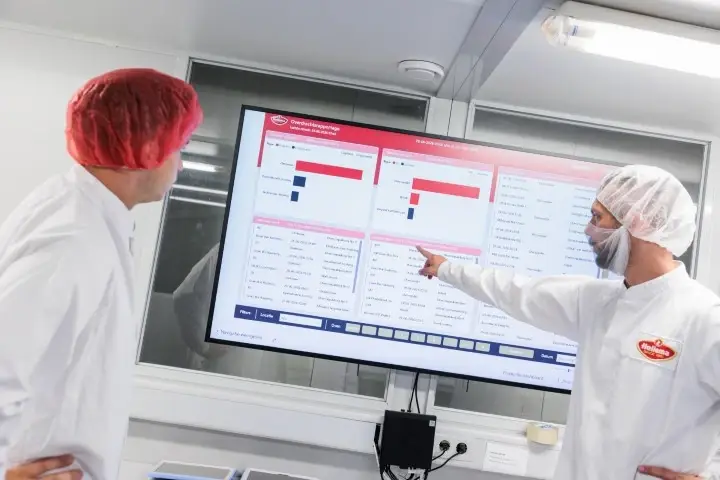
“At first, operators were sceptical about yet another screen. After two weeks they were the ones complaining if a screen was missing somewhere.”
The shop floor is where all the themes come together.
Read more on this subject
Give your team an extra pair of eyes.
Book a Quick Scan.
In half a day we show what an AI operator assistant looks like in your production. Not a demo of someone else's plant, but a setup for yours.