To a maintenance department, TPM quickly sounds like 'more work on top' or 'soon the operator will be doing my job'. In practice the aim is the opposite: to share the work out better, so that the first-line tasks sit with the operator and the maintenance department has time left for diagnosis and for genuinely preventing breakdowns.
How the work is shared out
Operators take on the first-line care of their own machine: keeping it clean, inspecting it, lubricating it and reporting small deviations early. The maintenance department focuses on diagnosis, complex maintenance and improvements that prevent recurrence. That way not everything lands on the maintenance department’s plate, and problems are spotted sooner, by the people closest to the machine.
Autonomous maintenance in practice
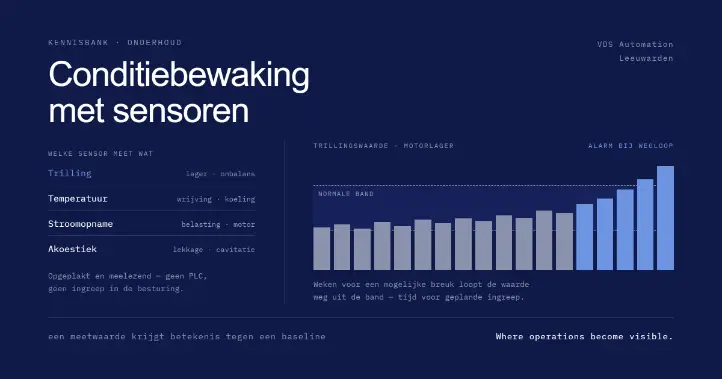
Autonomous maintenance is the operator part of TPM. It only works if operators know what to watch for and have a clear escalation path. Measurement data helps with that: an operator does not have to guess whether something 'sounds odd' when a vibration or temperature reading confirms it.
The link with OEE and the six big losses
TPM focuses on the six big losses that determine your OEE: breakdowns, changeovers, minor stops, speed loss, start-up loss and rejects. Autonomous checks based on figures are exactly what keeps minor stops and incipient breakdowns small, the losses that otherwise drain away unnoticed.
Practical example (illustrative)
An operator sees a vibration alarm for his line on his screen. He runs the agreed first check, and if that does not resolve it straight away he escalates to the maintenance department with the measurement data attached. The engineer arrives with a purpose, with a picture of what is going on, instead of searching blind.
Does this make my expertise redundant?
No. Autonomous checks do not replace the specialist, they absorb the routine work and actually make the maintenance department’s knowledge easier to use and to pass on. The diagnosis, the complex repairs and the improvement decisions stay with the maintenance department. VDS supplies the measurement that gives operators and engineers the same facts; who does what is up to you.
Frequently asked questions
What is TPM?
Total Productive Maintenance: an approach in which operators and the maintenance department jointly make sure machines stay as available and reliable as possible.
What is autonomous maintenance?
The part of TPM in which operators themselves carry out daily checks, cleaning and small maintenance tasks and report deviations early.
What is the relationship between TPM and OEE?
TPM tackles the six big losses that determine your OEE: breakdowns, changeovers, minor stops, speed loss, start-up loss and rejects.
Does the operator take over the maintenance department’s work?
No. The operator does first-line checks; diagnosis and complex maintenance stay with the maintenance department. The work is shared out, not shifted.