The question is rarely 'which one is best', but 'where does which approach pay off'. For a cheap, non-critical part a fixed interval is fine; on an expensive or failure-prone machine that same interval can cost you money. It is about the right strategy per machine, not one approach for everything.
Three strategies side by side
- Reactive: repairing after failure. No maintenance costs up front, but expensive and unplanned downtime when things go wrong, often with knock-on damage.
- Preventive: a fixed interval by time or running hours. It prevents many failures, but you regularly replace too early (throwing away good parts) or just too late (failure between two intervals).
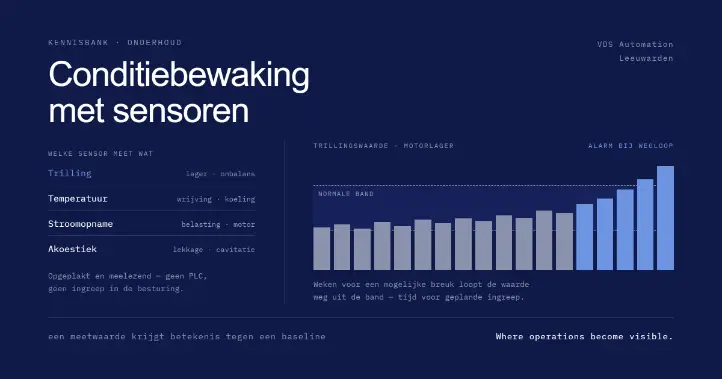
- Predictive: based on measured condition. You step in when the data calls for it: fewer surprises and less waste, but it does require a measurement.
When each approach pays off
Three questions decide it: how bad is a failure (cost, safety, delivery reliability), how predictable is the wear, and is the condition measurable? The higher the impact of failure and the better it can be measured, the sooner predictive maintenance pays off. For simple, cheap parts with predictable wear, a fixed interval remains the logical choice.
Example from practice (illustrative)
A critical pump is overhauled preventively every six months. In practice it sometimes breaks down after four months (failure between intervals) and is sometimes still fine after a year (replaced too early). With condition monitoring on vibration and temperature you replace exactly when the data shows a trend: not too early, not too late.
You do not have to make everything predictive
Most factories use a mix: reactive for the non-critical, preventive for the predictable, predictive for the critical and expensive. You decide per machine where the line lies. VDS supplies the measurement wherever you choose predictive; the strategy and the choice stay with the maintenance department.
Frequently asked questions
Which is better, preventive or predictive maintenance?
That depends on the machine: predictive pays off on expensive or failure-prone machines with measurable wear; preventive is enough for cheap, predictable parts.
When do you choose predictive maintenance?
When unexpected failure is expensive or dangerous and the condition can be measured with sensors.
Can you combine preventive and predictive?
Yes. Most factories use a mix per machine, depending on criticality and measurability.
Why is a fixed interval not always right?
Because you then replace on the calendar rather than on the actual condition: sometimes too early (waste), sometimes too late (failure between intervals).