Steps
- Record the deviation with time and batch
- Root cause: five whys or Ishikawa, backed by the process data from that moment
- Corrective action: solve the specific case
- Preventive action: prevent recurrence
- Verify the effect and embed it
Example (illustrative)
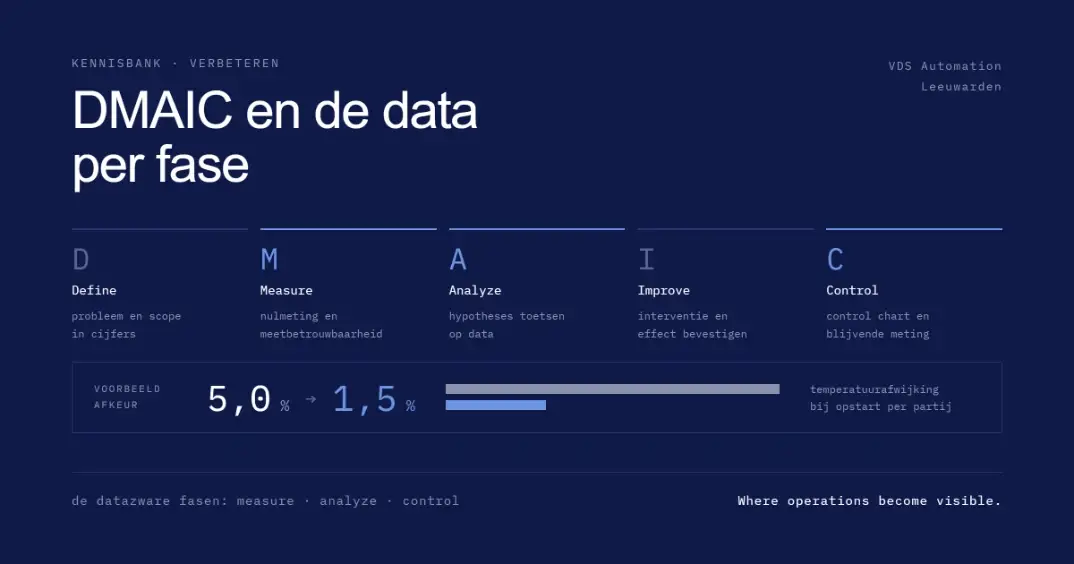
A spike in rejects → five whys → the process data shows a temperature deviation at start-up → a measure plus monitoring of that parameter. Without the data from that moment, the cause stays guesswork.
Root cause stands or falls with data
The cause can only be traced if you know which batch, setting and shift were involved. VDS supplies that data; the analysis and the measure stay with QA. Verifying the effect means measuring again.
Frequently asked questions
What is the difference between a corrective and a preventive action?
A corrective action solves the specific problem; a preventive action stops the same problem from coming back.
What is root cause analysis?
Systematically establishing the real underlying cause of a deviation, instead of treating the symptom.
How do you verify a CAPA?
By measuring again after the measure and showing that the deviation has gone and does not return.
EB