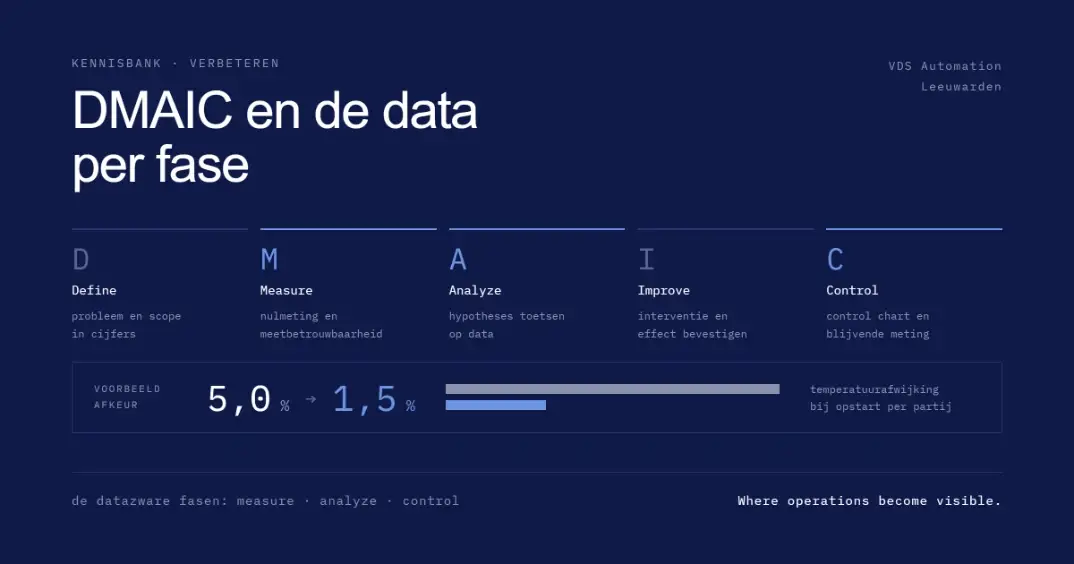
The five phases
- Define: problem and scope in figures, plus what it costs
- Measure: baseline measurement and measurement reliability (can the measurement itself be trusted?)
- Analyze: test cause hypotheses against data (Pareto, correlation by shift, batch, setting)
- Improve: carry out the intervention and confirm the effect
- Control: lock it in with a control chart and continued measurement
Example (illustrative)
Define: 5% rejects. Measure: first pass yield as the baseline. Analyze: rejects turn out to correlate with a temperature deviation at start-up per batch. Improve: setting adjusted. Control: monitor the process limits so that it does not come back.
VDS in Measure, Analyze and Control
The data-heavy phases are Measure, Analyze and Control, exactly where separate systems fall short. VDS supplies the measurement layer; you draw the conclusions and choose the intervention.
Frequently asked questions
Which data belongs to the Measure phase?
A reliable baseline measurement of the outcome KPI, plus a check that the measurement itself is consistent.
What is the difference between DMAIC and PDCA?
DMAIC is a structured project approach for complex problems; PDCA is a lighter, continuous improvement loop.
What is measurement reliability, briefly?
The question of whether repeated measurements of the same thing under the same conditions give the same result; if not, every analysis based on them is unreliable.