Almost every maintenance department knows the scenario: called out at night for a machine that has failed, while afterwards you 'knew' it had not been running well for a while, only that feeling was never written down anywhere. Predictive maintenance turns that feeling into a measurable signal, so a breakdown becomes a planned intervention instead of a surprise in the middle of production.
How predictive maintenance works
At its core is a continuously measured condition signal that you compare against the normal behaviour of the machine. If the signal deviates structurally, that is the early sign of wear or a developing defect, well before the machine actually fails.
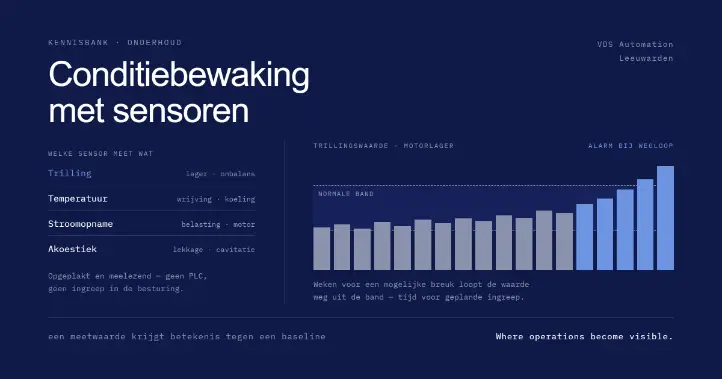
- Measure condition signals: vibration, temperature, current draw or sound
- Establish the normal behaviour (the baseline) of the machine
- Detect deviations and trends relative to that baseline
- Schedule the maintenance in a planned stop, before the failure
From reactive to condition-based: where the gain is
Reactive maintenance is cheap until it goes wrong, and then the bill is high: unforeseen downtime, rush parts, overtime and often consequential damage. Predictive maintenance moves those moments into a planned window. The gain is not in 'never a breakdown again', but in turning unplanned stops into planned ones: you choose when you step in, with the right parts and without catching the line by surprise.
It also makes downtime demonstrable. Where you now have a gut feeling about which machine is 'always trouble', you will have a trend line, usable to justify a maintenance budget or a replacement to your manager.
Practical example (illustrative)
On a bearing housing the vibration value slowly rises over a few weeks, a classic pattern for early bearing wear. Because you see that trend, you replace the bearing during the planned weekend stop, instead of an unexpected failure on a Tuesday afternoon with half a day of lost production behind it.
Does this work on my (older) machines?
Yes. The sensors measure passively, glued on or inductive, separate from the control system. So you do not have to touch the PLC and you do not have to replace your machinery. Because nothing is written to the control system, the machine supplier's warranty is generally not an issue; where it is a point of attention anyway, we confirm that per machine.
Who manages this, and does it become another job for me?
The measurement runs automatically: VDS supplies the sensor layer and 24/7 monitoring of the data collection. You keep the machine knowledge and carry out the maintenance. So it becomes your instrument, not extra administration and not supervision of the maintenance department. The data sits in your own environment.
In short: VDS measures and signals, you decide what happens with a signal and when.
Starting small
You do not have to instrument the whole plant. Start with the machine that causes the most unplanned downtime or whose failure is the most expensive. That is where predictive maintenance proves itself fastest, at the lowest threshold.
Frequently asked questions
What is the difference between predictive and preventive maintenance?
Preventive maintenance follows a fixed interval regardless of condition; predictive maintenance follows the actual measured condition and steps in exactly on time.
Which sensors do you use?
Usually vibration, temperature, current and sound, depending on the machine and the failure mechanism you want to spot early.
Does this work on old machines?
Yes. Because you measure passively with glued-on or inductive sensors, you do not have to touch the control system; that makes it applicable to older machinery as well.
Does my machine warranty lapse?
With passive measurement you do not touch the control system, so the warranty discussion generally does not arise, where it is a point anyway, we confirm it per machine.
Is the maintenance department's work taken over?
No. VDS supplies the measurement and the monitoring; the maintenance and the machine knowledge stay with the maintenance department. It is an aid, not a replacement.
Where should I start?
With the machine that has the most unplanned downtime or the most expensive failure, that is where predictive maintenance delivers results fastest.