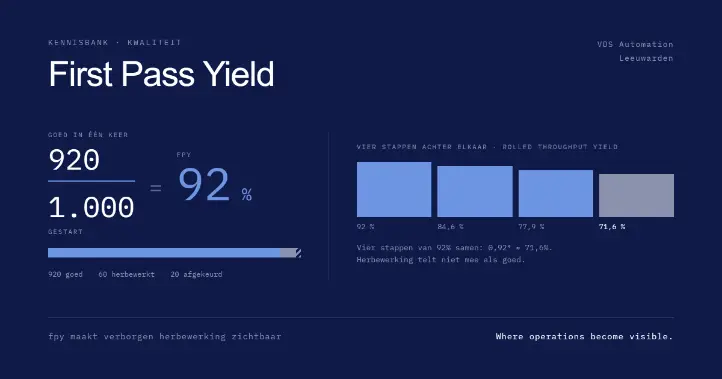
Worked example (illustrative)
1,000 units started, 60 reworked, 20 rejected → right first time = 920.
- FPY = 920 ÷ 1,000 = 92%
- Across four successive steps of 92% each → Rolled Throughput Yield ≈ 71.6% (0.92⁴)
Why FPY is stricter than ordinary yield
Ordinary (throughput) yield counts reworked units as good and so hides the cost of failure. FPY does not count rework, which makes hidden rework visible. That is also the difference with the quality factor in OEE, which counts good versus total but treats rework differently.
What VDS delivers
VDS measures good units, rejects and rework per step and per batch; QA interprets the figures and accounts for them to the customer, the auditor and the board.
Frequently asked questions
What is the difference between FPY and yield?
FPY counts only what is right first time; ordinary yield counts reworked units as good.
What is the difference between FPY and the OEE quality factor?
The OEE quality factor looks at approved versus total; FPY is stricter because rework does not count as 'good'.
What is Rolled Throughput Yield?
The product of the FPY of all successive steps: the probability that a unit passes through every step right first time.