This is not a compliance question but a growth question, which is why it belongs at board level. A connection that cannot be made heavier blocks a new line, a heat pump or charging infrastructure, no matter how much headroom your total consumption shows on paper.
Peak power versus total consumption
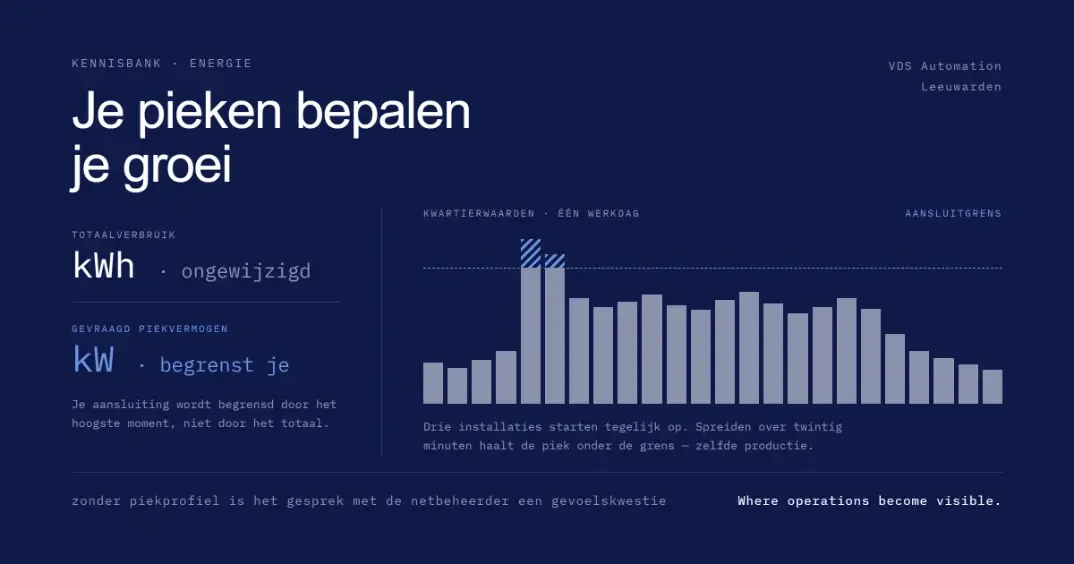
Total consumption (kWh) is how much energy you use over a period; peak power (kW) is the highest instantaneous power you draw. Your connection and your transport capacity are limited by that peak power, not by your total. Two companies with the same annual consumption can have very different peak profiles, and therefore a very different grid problem.
Why you need a peak profile
Without a demonstrable peak profile, quarter-hour values or a load profile, the conversation with the grid operator comes down to gut feeling. With data you can show when the peaks occur, how high they are and whether they are structural or one-off. That turns the question from 'we want more' into 'this is our profile, and this is the capacity we need'.
What a peak profile lets you do (and what VDS does not do)
A substantiated peak profile makes concrete trade-offs discussable: spreading consumption over time, phased start-up, or buffering/peak shaving to lower the peak you draw without producing less.
VDS measures and shows the peak profile and the base load. VDS does not advise on energy contracts, tariffs or the application to the grid operator, and does not control any installations; those choices and negotiations stay with you and your advisers. The data is your ammunition, not the decision.
Worked example (illustrative)
Three installations start up at the same time every morning, producing a short but high peak that runs right up against your connection limit. Annual consumption does not change, but by spreading the start-up over twenty minutes the peak you draw drops below the limit, and suddenly there is room for that extra line. Without measurement data that peak would have stayed invisible behind the monthly total.
Why this is a board-level question
Grid congestion touches the growth strategy: expansion, electrification and sustainability projects all get stuck on it. For the board, a hard peak profile is therefore not a technical detail but the evidence underpinning an investment or site decision, and the difference between 'the grid is full' as an end point or as the start of a conversation.
Frequently asked questions
What is grid congestion?
A shortage of transport capacity on the network, which means applications for a heavier connection are refused or granted only much later.
What is the difference between peak power and total consumption?
Total consumption (kWh) is how much you use over a period; peak power (kW) is your highest instantaneous power, and it is the latter that determines your connection capacity.
What is peak shaving?
Flattening short consumption peaks, for example by staggering, phased start-up or buffering, so that the peak power you draw falls.
How do you make the case for a heavier connection?
With a demonstrable peak profile (quarter-hour values) that shows when your peaks occur, how high they are and whether they are structural, facts instead of assumptions.
Does VDS advise on my energy contract or grid connection?
No. VDS supplies the measurement data and the peak profile; the contract, tariff and grid-management questions stay with you and your advisers.