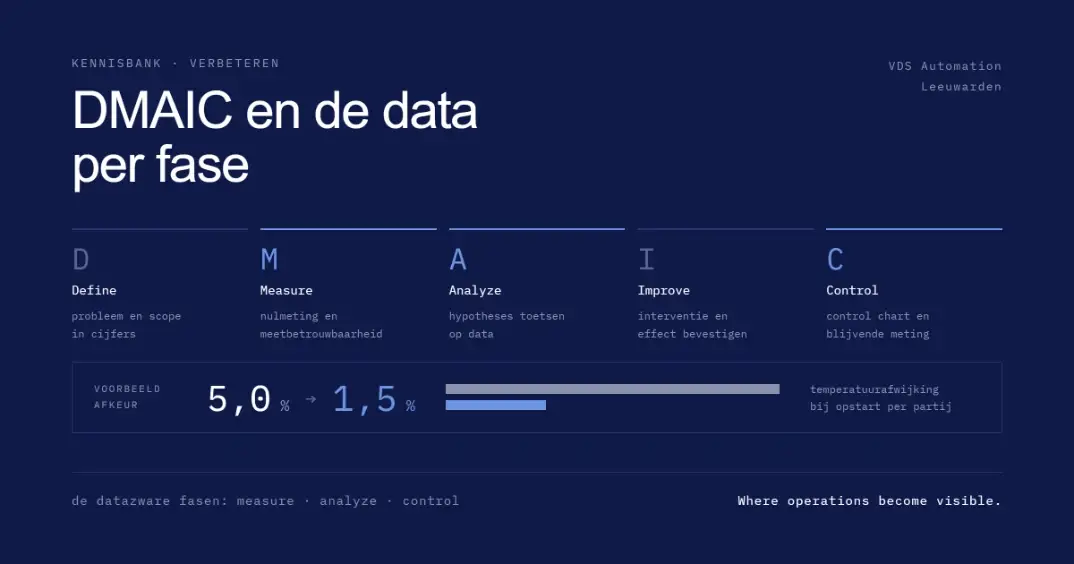
The four phases with data
- Plan: baseline measurement plus target in figures (e.g. changeover downtime 25% → target -30%)
- Do: carry out the intervention and record exactly what you change
- Check: measure again and compare with the baseline measurement
- Act: embed and standardise what works, discard what does not
Worked example (illustrative)
Plan: changeover time is 25% of the downtime, target -30%. Do: apply SMED. Check: changeover share 25% → 17%. Act: standardise the new working method and keep monitoring.
Why the Check phase often fails
Without reliable measurement, the Check stays a gut feeling. VDS supplies continuous measurement so that Check and Act rest on facts; the improvement work stays yours.
Frequently asked questions
Why does the Check phase often fail?
Because the data needed to test the effect is missing or arrives too late, so improvements are not embedded.
What is the difference between PDCA and DMAIC?
PDCA is a light, cyclical improvement loop; DMAIC is a heavier, data-driven project structure for more complex problems.
What data do you need for PDCA?
At minimum a reliable baseline measurement of the KPI you want to improve, plus the same measurement after the intervention.
EB