Condition monitoring is the foundation under predictive maintenance: without a continuous signal there is nothing in which to see a trend or a deviation. Its strength is that you can measure those signals without touching the machine or its control system.
Which sensor measures what
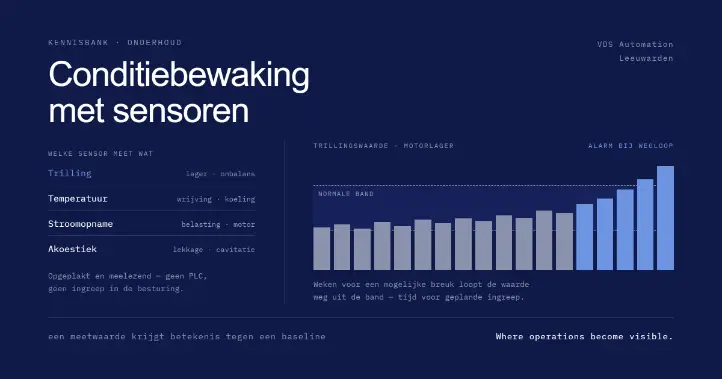
- Vibration: bearing wear, imbalance and alignment problems; often the earliest signal on rotating machines
- Temperature: overheating, friction and cooling problems
- Current draw: load and motor condition; a rising draw points to increasing resistance
- Sound/acoustics: leaks, bearing noise and cavitation
Passive measurement: why it works on old machines
The sensors are stuck on or fitted inductively and measure passively, separately from the control system. So you do not have to connect to the PLC and do not have to touch the machine logic. That is why condition monitoring also works on older machinery, and why the warranty and liability question stays small: nothing is written to the control system.
From signal to usable insight
A raw measured value says little; the value comes from setting it against a baseline. Continuous measurement makes trends and deviations visible and can raise an alarm as soon as a value starts drifting structurally. That is exactly the input predictive maintenance needs.
Practical example (illustrative)
A stick-on vibration sensor on a motor bearing measures continuously. Weeks before a possible failure the vibration value rises above the normal band. The alarm gives the maintenance department time to schedule a planned intervention instead of running an emergency repair.
Who manages the sensors
VDS supplies the sensors and the 24/7 monitoring of the data collection; the maintenance department stays in charge of the machine itself. The data sits in your own environment. The aim is that downtime becomes demonstrable so that your maintenance budget can be substantiated, not that the maintenance department gets supervised.
Frequently asked questions
Which sensors do you use for condition monitoring?
Mainly vibration, temperature, current and sound, depending on the machine and the failure mechanism you want to spot early.
Does condition monitoring work on old machines?
Yes, because you measure passively with stick-on or inductive sensors, separately from the control system.
Do I have to connect to the PLC?
Not necessarily. Passive measurement is possible without touching the control system, which keeps the warranty question small.
Who manages the sensors?
VDS supplies and monitors them; the maintenance department stays in charge of the machine itself. The data stays in your own environment.
What is the difference with predictive maintenance?
Condition monitoring is measuring the state; predictive maintenance is using that measurement to schedule maintenance before a breakdown.