Actual versus ideal cycle time
The actual cycle time is what you measure on the line, including small losses. The ideal cycle time is the speed the machine was designed for. The difference between the two is speed loss, precisely the performance factor in your OEE.
Worked example (illustrative)
A line runs 420 effective minutes and makes 1,400 units.
- Actual cycle time = 420 ÷ 1,400 = 0.3 min = 18 seconds per unit
- Ideal cycle time = 15 seconds → 3 seconds of speed loss per unit
Why this affects your output
Speed loss is loss that never shows up as downtime anywhere, the line is running, just slower than it could. VDS measures the actual cycle time per line and per product; you decide whether that is fast enough and where you adjust.
Frequently asked questions
What is the difference between cycle time and takt time?
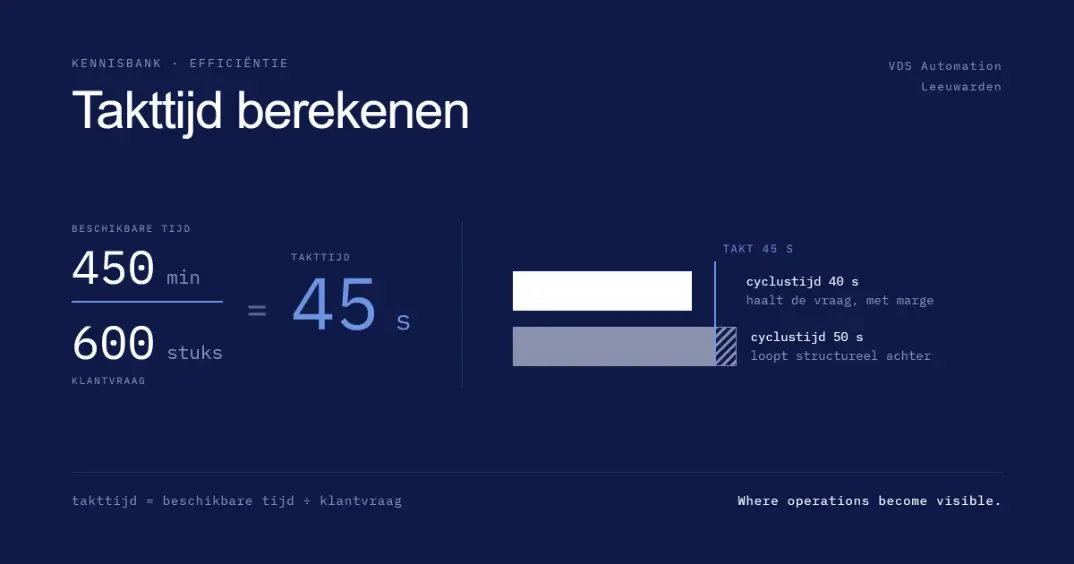
Cycle time is how fast you actually produce; takt time is how fast you have to produce to meet customer demand.
What is a good cycle time?
As close as possible to the ideal cycle time of the machine, and no slower than the takt time.
How do you reduce cycle time?
By tackling speed loss: minor stops, start-up losses and running below speed. That starts with measuring per line and per product.