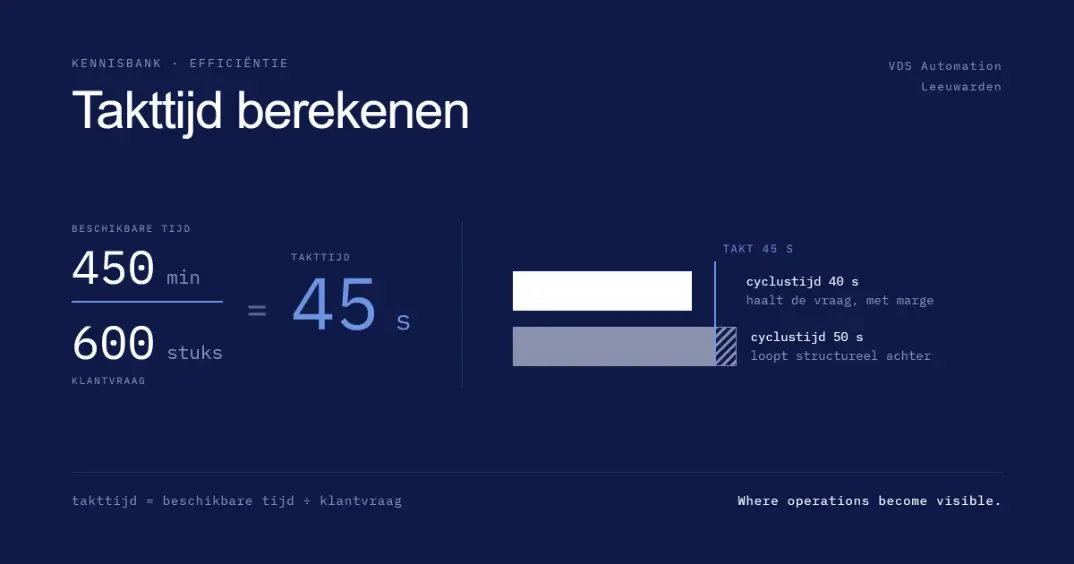
Worked example (illustrative)
A shift has 450 available minutes and customer demand is 600 units per shift.
- Takt time = 450 ÷ 600 = 0.75 min = 45 seconds per unit
- Cycle time 40 sec → you meet demand with room to spare
- Cycle time 50 sec → you fall behind demand structurally
Why takt time is about delivery reliability
Takt time ties your production rhythm directly to what the customer asks for. As soon as your cycle time rises above the takt time, a backlog builds up and delivery dates come under pressure. VDS measures your actual cycle time so you can set it against the takt; the planning and the adjusting stay with you.
Frequently asked questions
What is the difference between takt time and cycle time?
Takt time is the required rhythm based on customer demand; cycle time is your actual production speed.
What if the cycle time is higher than the takt time?
Then you are producing more slowly than demand and your deliveries fall behind; you need more capacity, more speed or more time.
How do you determine the customer demand for the takt time?
From the order flow or the forecast for the period concerned, converted into units per unit of available time.
JW