
A deviation you spot early costs a fraction of a reject you spot too late.
Scrap and rework rarely appear out of nowhere. There is almost always a drift beforehand: a temperature running away, a weight creeping just outside the band, a batch that deviates. VDS Smart Factory makes those signals visible at the moment adjusting is still cheap, instead of at final inspection.

You check quality at the end. That is where you can no longer put it right.
In most factories, quality is only measured at final inspection or in the lab. By then the rejected batch has already been made, the material already used and the time already spent. The deviation was often building up hours earlier, but nobody saw the pattern in time.
What is left is rework, discarded product and a complaint you have to explain after the fact, without knowing exactly which batch, line or setting made the difference.
Measured too late
The rejects show up at final inspection. The cause lay hours earlier in the process.
Rework is invisible
What has to go through the line again rarely counts in the figures. Yet it costs capacity and margin.
Cause untraceable
Which batch, setting or supplier caused the deviation? Working that out takes days.
A complaint with no evidence
A customer reports a problem. You cannot quickly look up what really happened that day.
A reject does not only cost material. It costs the time you put into it, the rework afterwards, and the capacity you never get back.
Process data and quality side by side. In real time.
VDS Smart Factory links process values from your machines, sensors and lab to the quality of what you make. As soon as a value runs outside its normal band, that is visible straight away at the line, with the batch, the product and the setting alongside it. That way you step in before the deviation turns into rejects.
Weight has been above the upper limit since 13:10. Drift comparable to batch #2208, which was then linked to dosing valve 2.
First pass yield per line
How much you get right first time, live per line, product and shift. Rework counts visibly towards it.
Process limits monitored
Temperature, weight, pressure or speed are monitored against their normal band. Drifting away immediately becomes a signal at the line.
Traceable down to the batch
Every deviation can be traced back to batch, setting and moment. You answer a complaint with facts, not with assumptions. Because every measurement is recorded with time, line and batch, your quality is demonstrable in an audit or a customer query. That fits the requirements from certification schemes such as BRCGS, IFS or HACCP.
The pattern behind the rejects is often in data nobody puts side by side.
Quality rarely depends on a single knob. It is the combination of batch, setting, temperature and time. AI makes those connections continuously, so that you do not discover what they had in common only after the third complaint.
See the drift before it is out of spec
Models learn the normal band of your process values, per product and line. As soon as a value starts drifting away structurally, that is a signal, well before the product is rejected.
Which factors rejects have in common
Rejected batches are automatically compared on setting, batch, supplier and moment. The system shows what they share, so that improvement projects start from facts.
Quickly back to what happened that day
With a complaint you look up in seconds which batch, line and settings belonged to it. No days of detective work through separate systems.
This is what is in place after handover.
Delivered ready to use, including the reports you need for an audit.
How a deviation is caught.
Four steps, the first three of which take place within the same shift.
Measure
Critical parameters are read out continuously from PLCs and sensors, per line and per product.
Signal
If a value departs from the process limit or drifts away structurally, an alert goes out immediately.
Step in
The operator sees at the line what is going on and adjusts, before a batch has left the building.
Lock in
Cause and action are recorded. At the next audit the file is already there, and recurrence becomes visible.
Every sector has its own standard. The evidence underneath is always the same.
BRCGS asks something different from IATF 16949, and an AS9100 audit looks nothing like an IFS audit. But what an auditor ultimately always wants to see is the same: that you measure the critical parameters, that you demonstrably followed up on deviations, and that you can retrieve it without spending a week searching through folders. We set up that layer. The standard only determines which fields and report formats have to come out of it.
Food and food-related
BRCGS · IFS · FSSC 22000 · HACCP
- CCPs measured continuously instead of signed off by sampling
- Batch traceability from raw material to pallet, searchable within minutes
- Deviation, cause and corrective action in one file per batch
- Reporting ready for an unannounced audit
Metal, engineering and automotive
ISO 9001 · IATF 16949 · EN 1090 · AS9100
- Process parameters recorded per order and per batch run
- Measurement data linked to certificates and material provenance
- Evidence for SPC, capability and first article inspection
- Rejects and rework traceable back to machine and setting
Sector-independent
ISO 9001 · ISO 14001 · ISO 50001 · customer audits
- One data source, so no difference between what the floor says and what the report says
- Automatic logging: nobody has to reconstruct anything after the fact
- Exports for auditors, customers and your own quality department
- Data stays in your own environment, so you are nobody’s hostage
We are not a certification body and we do not pretend to know your standard better than your quality manager does. What we do: sit down with that quality manager to work out which evidence really has to come out of the system, and build that in.
Discuss your standard →From explaining rejects to preventing them.
The gain is not in checking more strictly, but in seeing sooner. If the drift is already visible at the line an hour before final inspection, the operator adjusts before the batch is lost. That saves material, rework and line time, every single day.
Read: spotting deviation before rejects →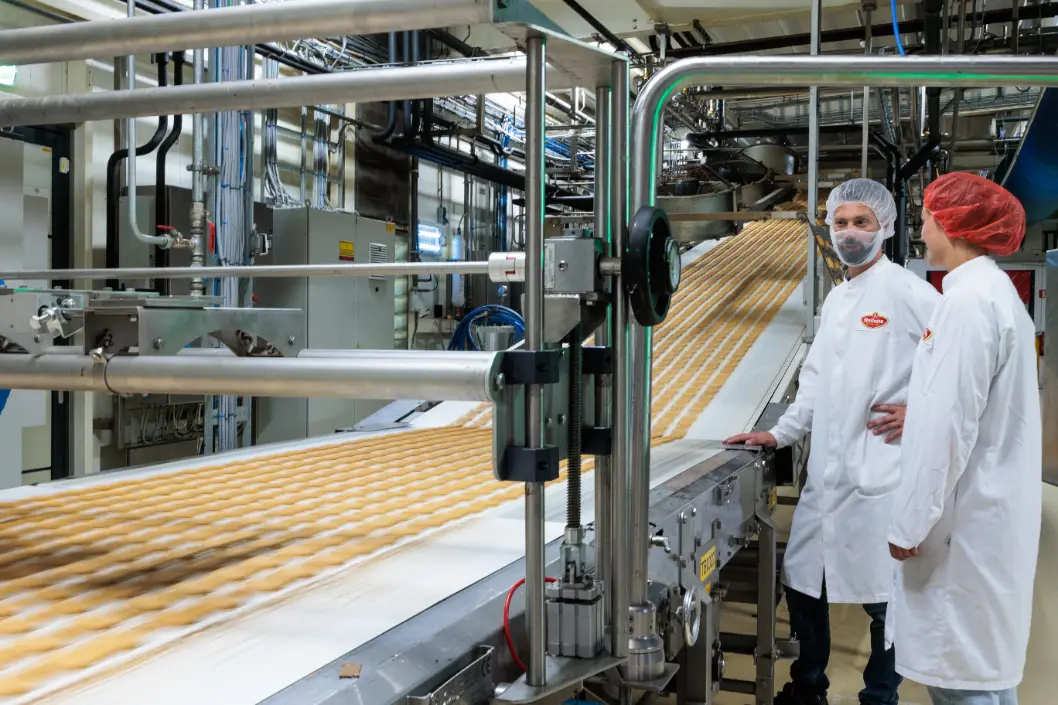
An example from practice: rejects often turn out to be concentrated in a few fixed moments each week. Once you see that pattern, you can step in precisely instead of searching broadly.
Rejects rarely start with quality alone
Read more on this subject
Find out where your scrap comes from.
Book a Quick Scan.
In half a day we look at your process and quality data with you and show you where your rejects and rework can be spotted, and prevented, sooner.